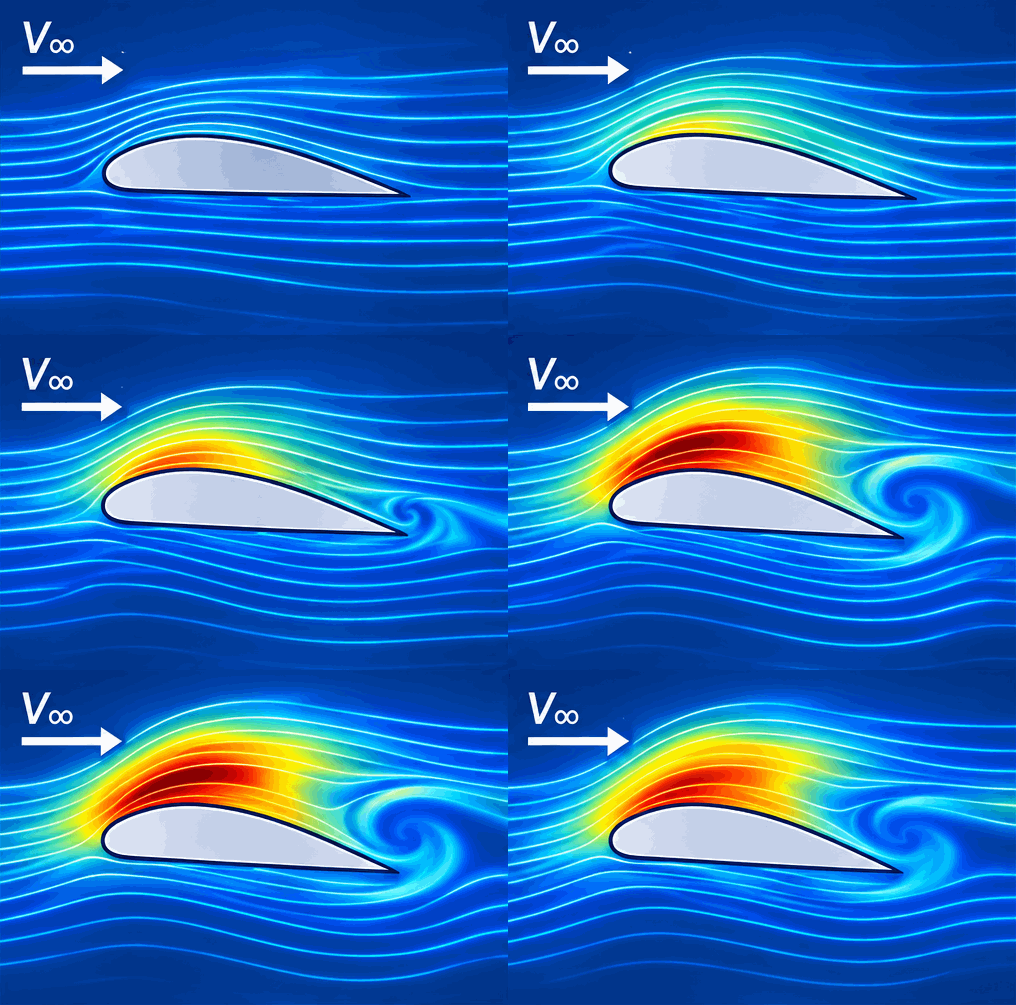

Topic outline

  • General

  • COURSE INFORMATION

    • ✈️

      AERODYNAMICS

      Master 1 – Energy Physics and Renewable Energies

      MASTER 1 | ACADEMIC YEAR 2026–2027

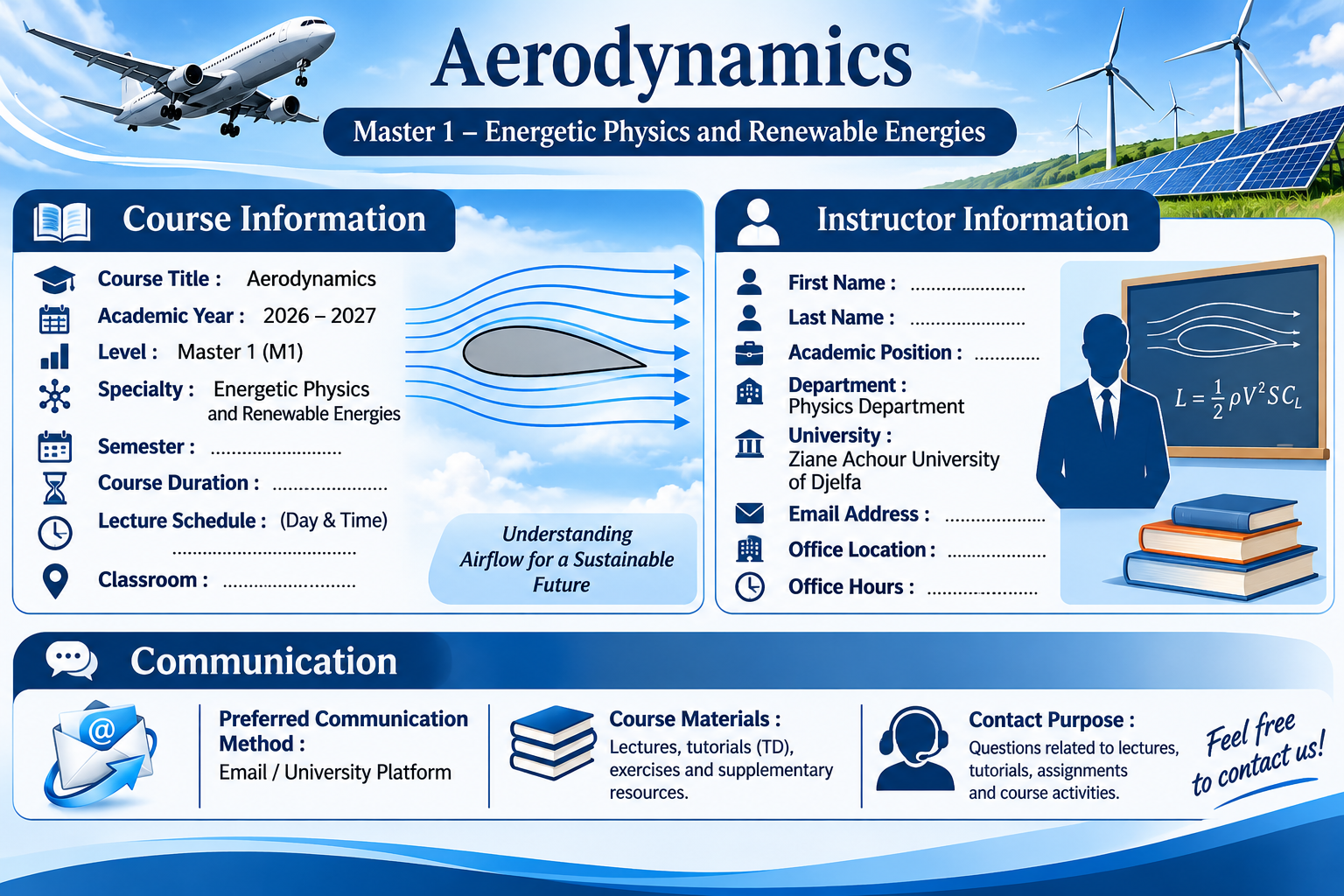
      📘 COURSE INFORMATION

      🎓 ACADEMIC YEAR
      2026–2027
      📚 LEVEL
      Master 1
      ⚡ SPECIALTY
      Master 1 – Energy Physics and Renewable Energies
      📅 SEMESTER
      S1
      ⏳ COURSE DURATION
      12–14 Weeks
      🕗 LECTURE SCHEDULE
      Saturday | 08:00–11:00
      🏫 CLASSROOM
      Room 12

      👨‍🏫 INSTRUCTOR INFORMATION

      👩‍🏫

      Dr. Zehor Allam

      Associate Professor (Class A)
      Department: Physics Department
      University: Ziane Achour University of Djelfa

      🌬️ EXPLORE THE COURSE

      Discover the main concepts and topics covered in this course.

      Aerodynamics Course Poster
      ✈️ 🌬️

      AERODYNAMICS | MASTER 1 | 2026–2027

      Ziane Achour University of Djelfa

  • Course Objectives

    • 🎯

      COURSE OBJECTIVES

      What You Will Learn and Achieve

      This course aims to provide students with essential knowledge and skills in aerodynamics, combining theoretical understanding with practical engineering applications.

      📖

      01. Fundamental Knowledge

      The main objective of this course is to provide students with the theoretical and practical foundations necessary to understand aerodynamic phenomena and their applications in the design and analysis of aeronautical and wind energy systems.

      ⚙️

      02. Technical and Practical Skills

      The course also aims to develop students' skills in aerodynamic modelling, numerical simulation, and experimental investigation, enabling them to analyze airflow behavior and evaluate aerodynamic performance in various engineering applications.

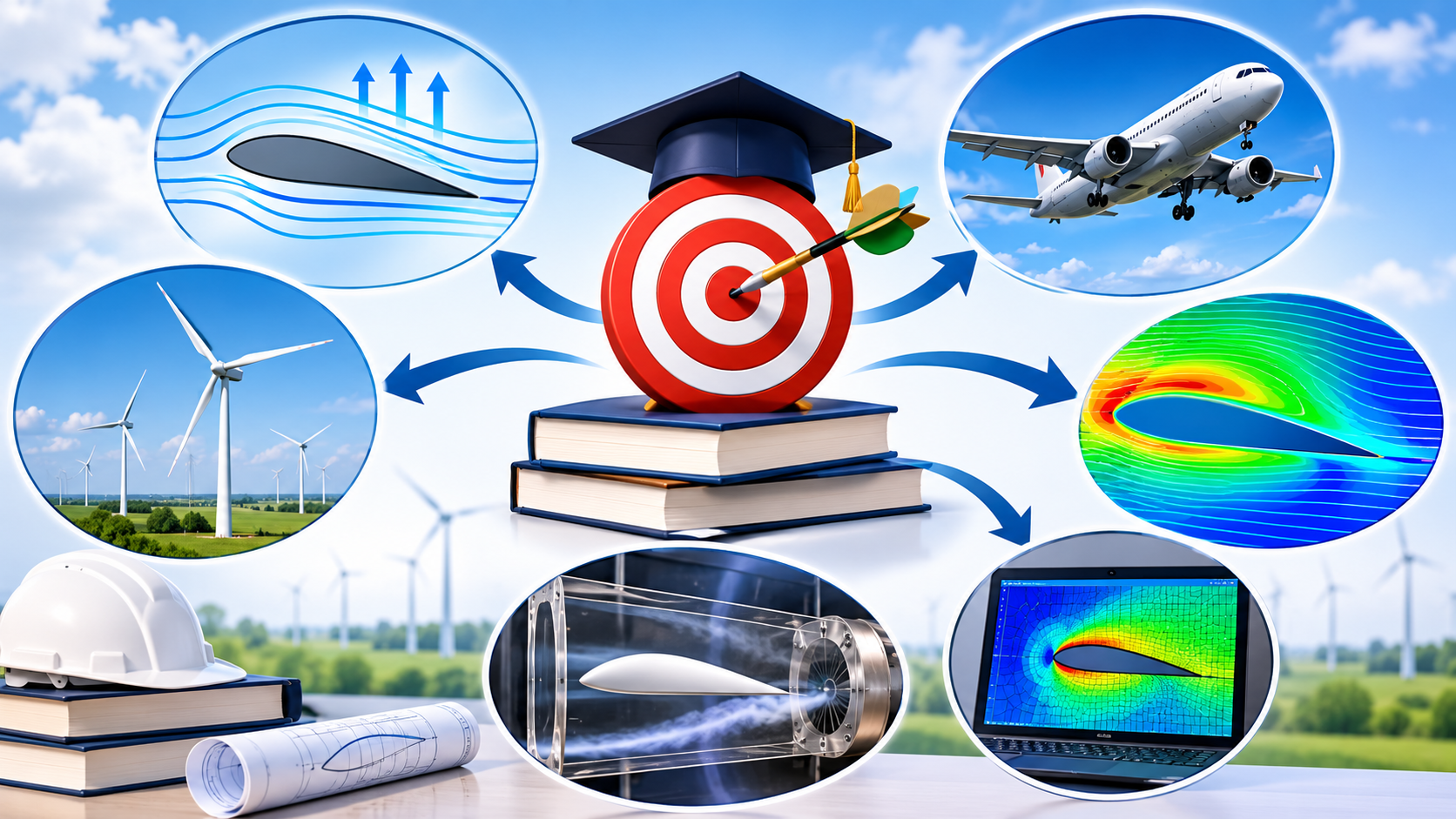
      🌬️ YOUR LEARNING PATHWAYS

      From fundamental concepts to advanced aerodynamic applications.

      Aerodynamics Learning Pathways

      ✈️ Understand • Model • Simulate • Analyze

      Aerodynamics | Master 1 | 2026–2027

  • Prerequisites

    • 🎓

      COURSE PREREQUISITES

      Essential Knowledge Before Starting

      To successfully follow this course, students are expected to have a basic background in fluid mechanics and fundamental aerodynamic concepts.

      💧

      01. Classical Fluid Mechanics

      A good understanding of classical fluid mechanics, particularly the Navier–Stokes equations and Bernoulli's principle, is essential.

      📐

      02. Dimensionless Numbers and Aerodynamics

      Students should also have basic knowledge of dimensionless numbers, such as the Reynolds and Mach numbers, as well as fundamental fluid flow and aerodynamic principles.

      📘 Review the Fundamentals • Build Your Aerodynamics Knowledge

      Aerodynamics | Master 1 | 2026–2027

  • Chapter 1

  • Chapter 2

    • 🎯 Main Objective of the Chapter

      The main objective of this chapter is to understand the fundamental characteristics of fluid flow around bodies, examine the development of boundary layers and flow separation, and analyze the formation of vortices and the influence of body shape on aerodynamic drag.

      📚 Specific Learning Objectives

      01

      Flow Around a Cylinder and a Sphere

      Understand and describe the main characteristics of fluid flow around cylindrical and spherical bodies, and identify the differences between two-dimensional and three-dimensional flows.

      02

      Boundary Layer Theory (Prandtl)

      Explain the concept of the boundary layer, understand its physical origin and development along a solid surface, and describe the fundamental assumptions of Prandtl's boundary layer theory.

      03

      Flow Separation and Vortex Formation

      Explain the physical mechanisms responsible for boundary layer separation, identify the conditions leading to flow separation, and understand the formation of vortices in the wake region.

      04

      Influence of Body Shape on Drag

      Analyze the influence of body geometry on aerodynamic drag, distinguish the main factors affecting drag, and understand how appropriate body shapes can reduce aerodynamic resistance.

      Aerodynamics | Master 1 | Academic Year 2026–2027
    • Opened: Wednesday, 25 November 2026, 12:00 AM
      Due: Tuesday, 15 December 2026, 12:00 AM
    • Chapter 2: Flow Around Bodies

      Interactive Aerodynamics Simulation

  • Chapter 3

    • 🎯 Main Objective of the Chapter

      The main objective of this chapter is to understand the aerodynamic characteristics of airfoils, examine the physical mechanisms responsible for lift and drag generation, interpret aerodynamic polar curves, and analyze the influence of ground effect and wingtip effects on aerodynamic performance.

      📚 Specific Learning Objectives

      01

      Airfoil Geometry and Characteristics

      Identify and describe the main geometric characteristics of airfoils, including chord length, camber, mean camber line, leading edge, trailing edge, and angle of attack.

      02

      Physical Origin of Lift and Drag

      Understand the physical mechanisms responsible for lift and drag generation, analyze the pressure distribution around an airfoil, and explain the contributions of pressure and viscous forces to aerodynamic forces.

      03

      Aerodynamic Polar Curves (Cl and Cd)

      Define and interpret the lift coefficient (Cl) and drag coefficient (Cd), analyze their variations with the angle of attack, determine the lift-to-drag ratio, and identify the critical angle of attack and stall phenomenon.

      04

      Ground Effect and Wingtip Effects

      Explain the physical origin of ground effect and its influence on lift and drag, understand the formation of wingtip vortices, and analyze the relationship between finite wing geometry, induced drag, and aerodynamic efficiency.

      Aerodynamics | Master 1 | Academic Year 2026–2027
      Duration: 3 Weeks
    • Chapter 3: Aerodynamics and Simulation

      Interactive Aerodynamics Simulation

  • Chapter 4

    • CHAPTER 4

      Lift Theory

      🎯 Main Objective of the Chapter

      The main objective of this chapter is to understand the fundamental physical and mathematical principles governing lift generation, study the Kutta–Joukowski theorem and the concepts of circulation and vortices, and examine the aerodynamic behavior of two-dimensional and three-dimensional wings, including the distribution of lift along the wing span.

      📚 Specific Learning Objectives

      01

      Kutta–Joukowski Theorem

      Understand the physical meaning and mathematical formulation of the Kutta–Joukowski theorem, establish the relationship between lift, circulation, fluid density, and freestream velocity, and apply the theorem to calculate aerodynamic lift per unit span.

      02

      Circulation and Vortices

      Define circulation and vorticity, understand their physical significance in aerodynamic flows, explain the relationship between circulation and lift generation, and analyze the role of vortices in the flow around airfoils and wings.

      03

      Two-Dimensional and Three-Dimensional Wing Theory

      Distinguish between two-dimensional airfoil flow and three-dimensional finite-wing flow, understand the fundamental principles of wing theory, and explain the influence of wing geometry and aspect ratio on aerodynamic performance.

      04

      Lift Distribution Along the Wing Span

      Understand the variation of lift along the wing span, analyze the influence of wing geometry and circulation distribution on aerodynamic loading, and explain the relationship between lift distribution, induced drag, and overall wing performance.

      Aerodynamics | Master 1 | Academic Year 2026–2027
    • Chapter 4: Theory of Lift

      Interactive Aerodynamics Simulation

  • Chapter 5

    • 🎯 Main Objective of the Chapter

      The main objective of this chapter is to understand the behavior of wind flow around buildings and structures, analyze the distribution of aerodynamic pressures on building surfaces and their influence on thermal comfort, and explore bioclimatic design strategies that improve natural ventilation and indoor environmental quality.

      📚 Specific Learning Objectives

      01

      Wind Flow Around Buildings

      Understand the main characteristics of wind flow around buildings, identify stagnation regions, acceleration zones, flow separation, and wake formation, and explain the influence of building geometry and surrounding structures on airflow patterns.

      02

      Aerodynamic Pressures and Thermal Comfort

      Explain the distribution of wind-induced pressures and suctions on building facades and roofs, understand the influence of wind speed and direction on surface pressures, and analyze the relationship between outdoor airflow, indoor thermal comfort, and building energy performance.

      03

      Bioclimatic Design Strategies

      Identify and apply bioclimatic design principles to improve building performance, understand the influence of building orientation, shape, openings, and surrounding vegetation on wind flow, and explore passive design strategies adapted to local climatic conditions.

      04

      Impact on Natural Ventilation

      Understand the physical principles of wind-driven natural ventilation, explain the role of pressure differences between building openings, analyze cross-ventilation and single-sided ventilation, and evaluate the influence of building design on indoor airflow and ventilation efficiency.

      Aerodynamics | Master 1 | Academic Year 2026–2027
    • Chapter 5: Aerodynamics of Buildings and Structures

      Interactive Aerodynamics Simulation

  • Final Quiz

    • Final Quiz – Aerodynamics

      Final Quiz – Aerodynamics

      Master 1 – Physics

      Chapters 1 to 5 | Academic Year 2026–2027

      30 Multiple-Choice Questions | Total: 30 Points

  • Bibliography