

Topic outline
-
Course Title: Discovery the Methodology of Academic WorK
Faculty: Computer Science and Exact Sciences
Department: Material Sciences
Target Audience: 1st Year LMD (ST and SM)
Credits: 03
Coefficient: 03
Duration: 12 Weeks
Schedule: Tuesday, 3:00 PM - 5:00 PM
Location: THE AMPHITHEATER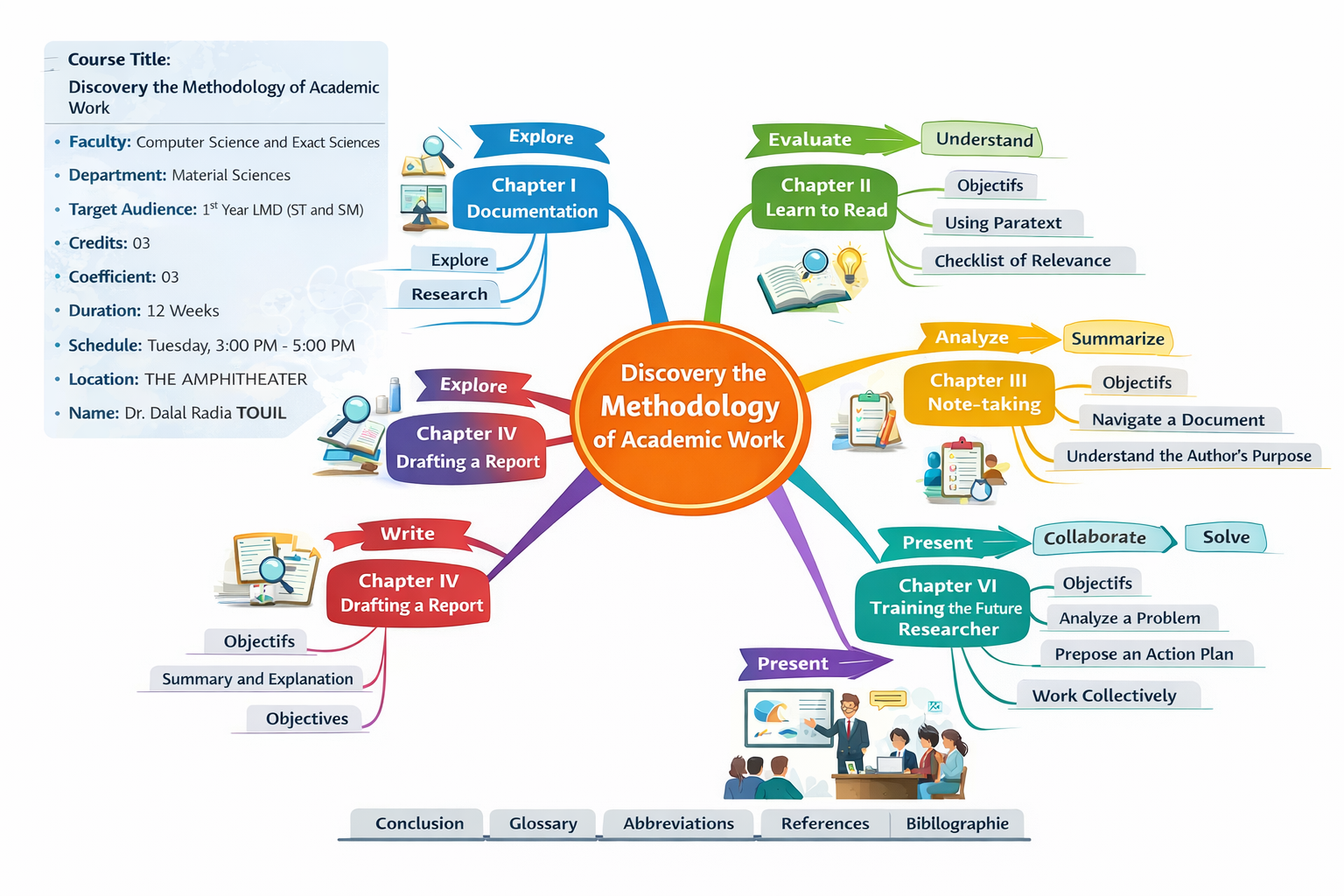
-
Name: Dr. Dalal Radia TOUIL
Email:d.touil@lagh-univ.dz
radia.touil@univ-djelfa.dz
Availability:
Office Hours: Sunday, Tuesday, Thursday (11:00 AM - 12:00 PM)
Forum: Preferred communication channel for course-related questions. Responses within 48 hours.
Email: Responses within 48 hours (barring unforeseen circumstances).
-
By the end of this course, students will be able to:
-
Identify and evaluate reliable information sources, including classical, audio-visual, and online documentation.
-
Take, organize, and use reading and lecture notes effectively to support learning and research.
-
Analyze texts and documents to locate key arguments and understand the structure of information.
-
Develop coherent written reports, lab summaries, and research memoires using structured writing strategies.
-
Demonstrate clear and effective oral communication in presentations, expressing ideas fluently and confidently.
-
Analyze research problems, propose evidence-based solutions, and work collaboratively in group projects.
-
Cultivate critical thinking, problem-solving, and independent research skills.

-
-
1. Foundational Mindset & Attitudes
Intellectual Curiosity: A willingness to ask "why" and "how," and a genuine desire to learn.
Openness to Change: The readiness to abandon inefficient high school study habits (like passive reading and cramming) and adopt new, more effective methods.
Self-Reflection: The ability to critically assess one's own current study habits, identify strengths and weaknesses, and a desire to improve.
Proactive Attitude: Understanding that university success depends on personal initiative and organization, not just following instructions.
2. Basic Academic & Cognitive Skills
Fundamental Literacy:
Reading Comprehension: Ability to understand the main idea and supporting details in a moderately complex text (e.g., a textbook chapter or a news article).
Writing Proficiency: Ability to write clear, complete sentences and organize a simple paragraph without major grammatical errors.
Basic Critical Thinking:
Ability to distinguish between fact and opinion.
Willingness to question information rather than accepting it at face value.
Time Management (Elementary):
Basic understanding of how to use a calendar or planner to record important dates (even if not yet proficient in planning study sessions).
3. Digital & Technical Literacy
Basic Computer Skills:
Ability to use a word processor (e.g., Microsoft Word or Google Docs) for writing.
Ability to navigate the internet for basic information searching.
Ability to use email formally (with a subject line, salutation, and clear message).
Familiarity with Learning Platforms: Basic knowledge of how to access and use the university's online learning management system (e.g., Moodle, Blackboard) is often a de facto prerequisite.
4. Organizational Skills
Personal Organization: A basic level of personal responsibility, such as the ability to keep track of one's own documents and materials.
What You Will BUILD in the Course
This course is designed to develop the following from the foundational skills above:
Advanced Time Management: Creating detailed weekly schedules, breaking down large projects, and avoiding procrastination.
Advanced Reading Strategies: Learning to skim, scan, and read critically for different types of academic texts.
Academic Writing Skills: Structuring essays and reports, using evidence, and citing sources properly.
Research Skills: Using library databases, evaluating sources (paratext!), and integrating research into writing.
Effective Note-Taking: Mastering methods like the Cornell System or mind mapping.
Collaborative Work: Learning how to effectively participate in and benefit from study groups.
 Quiz: 1 URLs: 3
 -
Objectifs
Introduction
I - Chapter 1 The documentation
1. Objectives
2. Documentation types
2.2. Audio-Visual Documentation
2.3. Internet Documentation
2.4. The Bibliography
II - Chapter 2 Learn to read
1. Objectives
2. Using Paratext to Evaluate Relevance
2.1. How to Use Paratext ?
2.2. Checklist to Evaluate Relevance
III - Chapter 3 Note-taking
1. Objectives
2. How to Navigate a Work / Document and Spot the Main Argumentative Elements ?
2.1. Method for Analyzing a Work / Document
2.2. Understanding the Author's Purpose
IV - Chapter 4 The drafting of a report
1. Objectives
2. Note-taking: Explanation
2.1. Writing a Summary Report – ExplanationV - Chapter 5 Preparing an oral presentation
1. Objectives
2. 1. Quality of Expression
2.2. Level of Preparation
2.3. Clarity of the Presentation
2.4. Respect for the Allotted Time
2.5. Clarity of the Speech (Delivery)
VI - Chapter 6 Training the Future Researcher
1. Objectives
2. definition
2.1. 1. Knowing How to Analyze a Problem
2.2. Recommending (or Proposing) an Action Plan
2.3. Working Collectively (Teamwork)
Conclusion
Glossaire
Abréviations
Références
Bibliographie -
 Google Meet™ for Moodle: 1 Chat: 1 Forum: 1
 -
Objectifs
- Classical Documentation
- Printed resources such as books, journals, encyclopedias, and reports.
- Audio-Visual Documentation
- Videos, documentaries, interviews, and educational recordings.
- Internet Documentation
- Online articles, digital libraries, databases, and web resources.
- Bibliography
- How to list and cite references correctly.
Chat: 1 Forum: 1 PDF Annotation: 1 SCORM package: 1 Quiz: 1 -
Objectives
- Identify the main paratextual elements of a document (title, abstract, keywords, authors, etc.).
- Recognize how paratext helps readers understand the context of a text before reading it fully.
- Analyze paratextual information to predict the content and purpose of a document.
- Evaluate the relevance and reliability of a document using its paratext.
- Use paratextual clues to guide an effective reading strategy.
Chat: 1 Forum: 1 SCORM package: 1 PDF Annotation: 1 Quiz: 1 -
Objectives
- Identify the key ideas and important sections of a text without reading every word.
- Locate relevant information quickly by moving efficiently through a text or book.
- Analyze the main arguments presented in a document.
- Recognize the organizational structure of a text.
- Select the most important information from a text for note-taking.
- Organize extracted information into clear and concise notes.
Chat: 1 Forum: 1 PDF Annotation: 1 SCORM package: 1 Quiz: 1 -
Objectives
- Identify different types of notes used in academic work, such as reading notes and lecture or conference notes.
- Summarize the main ideas, arguments, and key information from written sources through reading notes.
- Record essential points from lectures, seminars, or conferences efficiently.
- Apply abbreviations and symbols to take notes more quickly and effectively.
- Organize notes by topic, date, or source to facilitate review and study.
- Use collected notes to prepare summaries, reports, or research papers.
SCORM package: 1 Chat: 1 Forum: 1 PDF Annotation: 1 Quiz: 1 -
Objectives
- Develop clear and effective oral expression when presenting ideas.
- Use correct and precise language appropriate to the presentation topic.
- Apply suitable vocabulary to communicate ideas clearly to an audience.
- Pronounce words clearly and naturally during an oral presentation.
- Demonstrate confidence and fluency while speaking.
- Explain key ideas naturally instead of reading the text word for word.
PDF Annotation: 1 Chat: 1 Forum: 1 SCORM package: 1 Quiz: 1 -
Objectives
- Analyze research problems by identifying their causes, context, and implications.
- Differentiate between symptoms and the underlying causes of a problem.
- Formulate relevant and clear research questions.
- Collect and interpret information critically to understand complex issues.
- Break down complex problems into smaller and manageable components.
- Propose realistic and evidence-based action plans to address research problems.
- Design structured steps and strategies to achieve research objectives.
- Justify proposed solutions using data and research findings.
- Collaborate effectively with others in a research team.
- Communicate ideas clearly and contribute responsibly to collective work.
PDF Annotation: 1 SCORM package: 1 Chat: 1 Forum: 1 Quiz: 1 -
Quiz: 1 PDF Annotations: 2
-
Glossary: 1 PDF Annotations: 2