

مخطط الموضوع
-

-
Course title: Discovering the Methodology of Academic Work
Faculty: Computer Science and Exact Sciences
Department: Material Sciences
Target audience: 1st year LMD (ST and SM)
Credits: 3 · Coefficient: 3 · Duration: 12 weeks
Schedule: Tuesday, 3:00 PM – 5:00 PM · Location: Amphitheatre
Personal work: about 4 h 30 per chapter, 27 h in total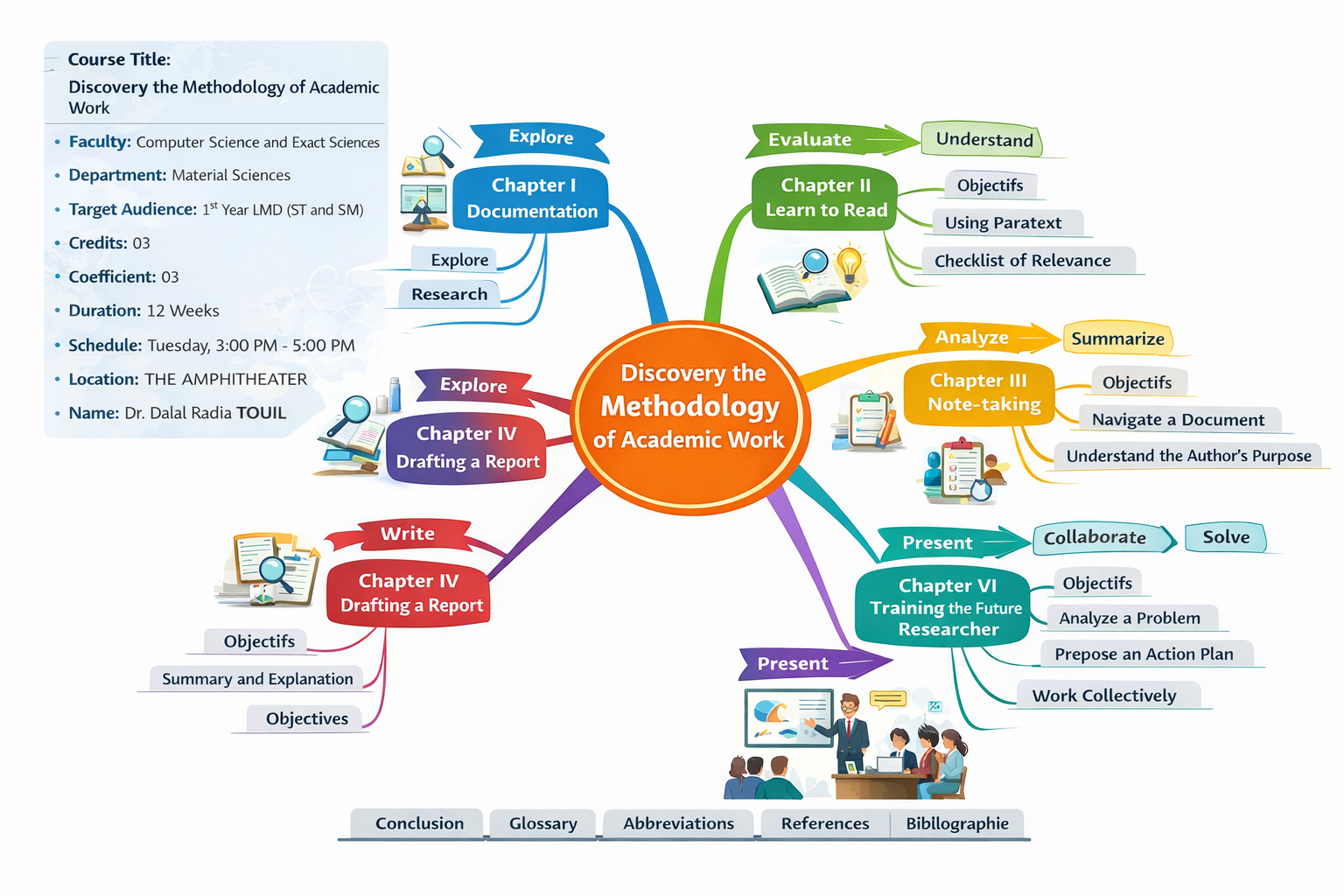
-
Name: Dr. Dalal Radia TOUIL
Email:d.touil@lagh-univ.dz
radia.touil@univ-djelfa.dz
Availability:
Office Hours: Sunday, Tuesday, Thursday (11:00 AM - 12:00 PM)
Forum: Preferred communication channel for course-related questions. Responses within 48 hours.
Email: Responses within 48 hours (barring unforeseen circumstances).
-
By the end of this course, students will be able to:
-
Identify and evaluate reliable information sources, including classical, audio-visual, and online documentation.
-
Take, organize, and use reading and lecture notes effectively to support learning and research.
-
Analyze texts and documents to locate key arguments and understand the structure of information.
-
Develop coherent written reports, lab summaries, and research memoires using structured writing strategies.
-
Demonstrate clear and effective oral communication in presentations, expressing ideas fluently and confidently.
-
Analyze research problems, propose evidence-based solutions, and work collaboratively in group projects.
-
Cultivate critical thinking, problem-solving, and independent research skills.

-
-
1. Foundational Mindset & Attitudes
Intellectual Curiosity: A willingness to ask "why" and "how," and a genuine desire to learn.
Openness to Change: The readiness to abandon inefficient high school study habits (like passive reading and cramming) and adopt new, more effective methods.
Self-Reflection: The ability to critically assess one's own current study habits, identify strengths and weaknesses, and a desire to improve.
Proactive Attitude: Understanding that university success depends on personal initiative and organization, not just following instructions.
2. Basic Academic & Cognitive Skills
Fundamental Literacy:
Reading Comprehension: Ability to understand the main idea and supporting details in a moderately complex text (e.g., a textbook chapter or a news article).
Writing Proficiency: Ability to write clear, complete sentences and organize a simple paragraph without major grammatical errors.
Basic Critical Thinking:
Ability to distinguish between fact and opinion.
Willingness to question information rather than accepting it at face value.
Time Management (Elementary):
Basic understanding of how to use a calendar or planner to record important dates (even if not yet proficient in planning study sessions).
3. Digital & Technical Literacy
Basic Computer Skills:
Ability to use a word processor (e.g., Microsoft Word or Google Docs) for writing.
Ability to navigate the internet for basic information searching.
Ability to use email formally (with a subject line, salutation, and clear message).
Familiarity with Learning Platforms: Basic knowledge of how to access and use the university's online learning management system (e.g., Moodle, Blackboard) is often a de facto prerequisite.
4. Organizational Skills
Personal Organization: A basic level of personal responsibility, such as the ability to keep track of one's own documents and materials.
What You Will BUILD in the Course
This course is designed to develop the following from the foundational skills above:
Advanced Time Management: Creating detailed weekly schedules, breaking down large projects, and avoiding procrastination.
Advanced Reading Strategies: Learning to skim, scan, and read critically for different types of academic texts.
Academic Writing Skills: Structuring essays and reports, using evidence, and citing sources properly.
Research Skills: Using library databases, evaluating sources (paratext!), and integrating research into writing.
Effective Note-Taking: Mastering methods like the Cornell System or mind mapping.
Collaborative Work: Learning how to effectively participate in and benefit from study groups.
 إختبار: 1 روابط الكترونية: 3
-
Objectives
Introduction
I - Chapter 1 Documentation
1. Objectives
2. Documentation types
2.2. Audio-Visual Documentation
2.3. Internet Documentation
2.4. Bibliography
II - Chapter 2 Learn to read
1. Objectives
2. Using Paratext to Evaluate Relevance
2.1. How to Use Paratext ?
2.2. Checklist to Evaluate Relevance
III - Chapter 3 Note-taking
1. Objectives
2. How to Navigate a Work / Document and Spot the Main Argumentative Elements ?
2.1. Method for Analyzing a Work / Document
2.2. Understanding the Author's Purpose
IV - Chapter 4 The drafting of a report
1. Objectives
2. Note-taking: Explanation
2.1. Writing a Summary Report – ExplanationV - Chapter 5 Preparing an oral presentation
1. Objectives
2.1. Quality of Expression
2.2. Level of Preparation
2.3. Clarity of the Presentation
2.4. Respect for the Allotted Time
2.5. Clarity of the Speech (Delivery)
VI - Chapter 6 Training the Future Researcher
1. Objectives
2. Definition
2.1. Knowing How to Analyze a Problem
2.2. Recommending (or Proposing) an Action Plan
2.3. Working Collectively (Teamwork)
Conclusion
Glossary
Abbreviations
References
Bibliography -
 Google Meet™ for Moodle: 1 محادثة: 1 منتدى: 1
-
By the end of the chapter, you will be able to:
- Distinguish classical, audio-visual and internet documentation.
- Choose a reliable source for an academic task.
- Write a correct bibliographic reference.
محادثة: 1 منتدى: 1 تعليق PDF: 1 حزمة سكورم: 1 إختبار: 1 -
You will be able to:
- Identify the paratextual elements of a document (title, abstract, keywords, authors).
- Use paratext to predict the content and purpose of a text.
- Evaluate the relevance and reliability of a document with a checklist.
محادثة: 1 منتدى: 1 حزمة سكورم: 1 تعليق PDF: 1 إختبار: 1 -
You will be able to:
- Skim a text to identify its key ideas.
- Scan a document to locate a specific piece of information.
- Identify the main argument and the structure of a document.
محادثة: 1 منتدى: 1 تعليق PDF: 1 حزمة سكورم: 1 إختبار: 1 -
You will be able to:
- Take reading notes and lecture notes using abbreviations and a method such as the Cornell system.
- Organise notes by topic, date or source.
- Write a summary report from your notes.
حزمة سكورم: 1 محادثة: 1 منتدى: 1 تعليق PDF: 1 إختبار: 1 -
You will be able to:
- Structure a short presentation with a clear introduction, body and conclusion.
- Use precise language and suitable vocabulary for the audience.
- Deliver the presentation fluently, within the allotted time.
تعليق PDF: 1 محادثة: 1 منتدى: 1 حزمة سكورم: 1 إختبار: 1 -
You will be able to:
- Analyse a research problem by separating symptoms from causes.
- Formulate a clear research question.
- Propose and justify an evidence-based action plan, working as a team.
تعليق PDF: 1 حزمة سكورم: 1 محادثة: 1 منتدى: 1 إختبار: 1 -
إختبار: 1 تعليقات PDF: 2
-
قاموس المصطلحات: 1 تعليقات PDF: 2